

Mosaic Connections in Kansas
Mosaic Connections in Kansas
By Rochelle Cross
State Operations Director
Dear Family and Friends of Mosaic,
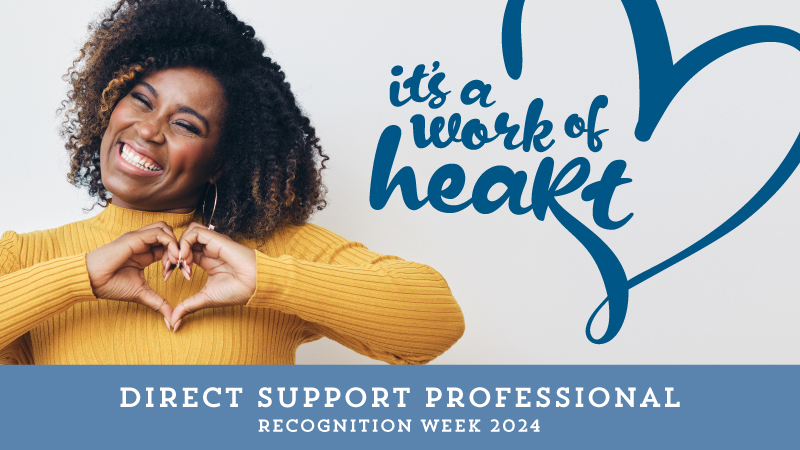
September 8 through 14 is National Direct Support Professional (DSP) Recognition Week, when Mosaic celebrates their vital and tireless work to help people we serve live the lives they choose by bringing Mosaic’s Mission Statement to “relentlessly pursue opportunities that empower people” to fruition. We and other service providers couldn’t do what we do without them.
Being a DSP isn’t a job—it’s often a calling. It is truly a “work of heart,” which is our theme for this year’s awareness celebration and campaign. While rewarding, the work of a DSP can also be physically demanding and emotionally draining. While Mosaic serves many people who have a higher degree of independence, we also serves others who have limited mobility—therefore needing assistance with activities of everyday life, such as dressing, getting in and out of bed or a chair, using the restroom or bathing.
Mosaic diligently advocates for higher pay for DSPs at national, state and regional levels. Their compensation has been chronically underfunded for decades and is dependent on government funding—which varies from state to state.
Mosaic’s Vice President of Government Relations Cheryl Wicks leads our DSP efforts along with advocating for IDD disability rights with 2,000 “Mosaic Allied Voices” volunteers. Being an advocate for these efforts is very easy, as it usually involves writing an email or making a phone call from your home; if you would like to be a part of Mosaic Allied Voices, please visit our web page.
Please enjoy our short “Work of Heart” video.
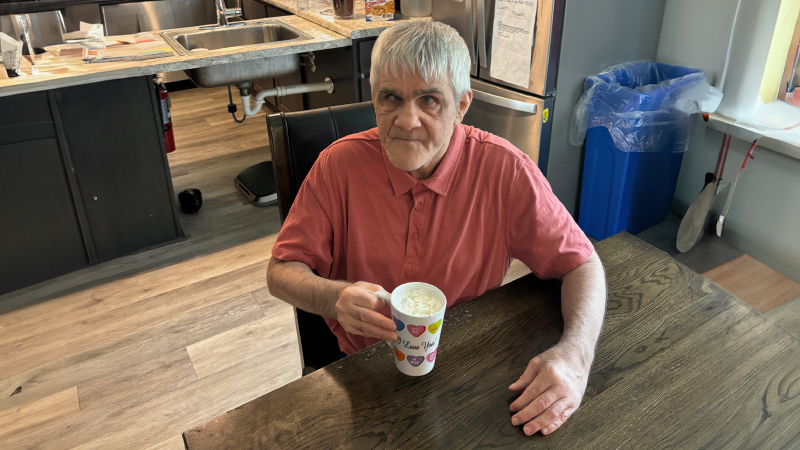
Every day, Mark likes to have his cup of coffee
Once Institutionalized, Mark is Now Using His Voice
“While I was only four years old when he left, I have many precious memories of things we did together,” said Mark Cunnane’s sister Louise Martin. “Being small, I didn’t even second-guess that on Saturdays, our family would go to visit Mark. That’s just what we did.”
Born with intellectual and developmental disabilities (IDD), Mark, now 68, was seven years old when his parents had to move him to an institution. “Mark was probably one of many people whose lives consisted of being sedated and placed in a corner,” Louise added. “While I can’t put the blame on anyone, I’m sure he was abused in some ways.”
As awareness grew about IDD and how to better help people who have them, the state closed the institution—and others—and moved people to group homes. “It was wonderful for him,” Louise said.
That was 30 years ago. The home was run by the state, and Mosaic took it over more than six years ago.
When she first met Mark, Mosaic Area Manager Allison Leue said, “Mark’s history showed he had stopped speaking around the age of 40 for ‘unknown reasons,’ but it was trauma-related from living in those institutional facilities. He also showed extreme behaviors to the point he didn’t want us to take him to any doctor appointments, which he really needed.”
“One of the biggest things Mosaic did for him was to wean him off of many medications,” said Louise. “Unfortunately, the medications did damage to his teeth, and he’s cross-eyed because of them. I’m sure there are other physical things adversely affected that can’t be seen. Emotionally, however, as he came off of the medicines, he wanted to partake in a lot more activities [such as going to a doctor] whereas he didn’t before.”
“Mark had a best friend for more than 50 years who was also in the same institution, and they were both transferred at the same time to the group home,” said Allison. “They were always together and helped each other. When his friend passed five years ago, it was tough for all of us, and we were especially concerned about Mark if it would set him back. But, it was a turning point for him—we think he may have held back on opportunities to protect his friend—because he actually blossomed and came into his own. He was even more up to trying and doing things, and his occasional words were coming out more.
“For example, two years ago, I was about to give him medicine his doctor wanted him to take for physical reasons,” Allison said. “He said ‘no’ to me, which made me more happy than I can describe! It was such a powerful moment for him to finally have the voice to say ‘no’ or ‘yes.’ Little by little, he started to use small phrases such as ‘I want more’ or ‘I don’t want that.’”
Mosaic’s April Johnson, who was Mark’s direct support professional at the time, said, “Also because of his increased communication, we discovered Mark’s favorites. I come in every morning with my coffee. One day, Mark took and drank it, and he definitely liked it. I started bringing coffee in the mornings for him as well. We sat at the kitchen table, and I would say, ‘good morning, Mark.’ Then I would put my hand out for a high-five, and he’d give me one. That’s how we started our day.”
April added, “I always communicated with Mark whether he was engaged or not to let him know ‘Someone is listening to you, I see you, and you are recognized.’”
“He also began to show and tell us other things he liked to do,” said April. “He likes to go out to eat, watch TV—especially game shows and soap operas—and go to movies. He’s also accomplished things such as picking up his dirty clothes and placing them in a laundry room hamper and taking his plate to the sink after he’s done eating.”
“Recently, the Mosaic staff told me they were all in the van discussing someone,” said Louise. “And my brother said clear as a bell, ‘I would not have thought that’ or something to that effect. Everyone turned around and looked at him, there in the back seat, sipping his coffee. So he can talk, he just chooses not to most of the time.”
“While he was first stand-off-ish, in the past two years, Mark is pretty game to go anywhere,” said Allison. “He feels more empowered now that he’s using his voice. He’s a really good guy. He’s very kind, smart, he’s very sweet and importantly, he’s well-loved,” Allison said. “He also shows his appreciation when you’re working with him or making sure he’s comfortable in the way he wants to spend his day.”
“He’s pretty smart in knowing how to make things go his way,” Louise said. “There are parts of him and his personality that just make me laugh; I love that he can figure his way around to do what he wants.”
Louise then added, “I think the older we get, the more we see we’re all really the same.”

Hard Data Proves Mosaic at Home® Improves Quality of Life for Those Served
While we intuitively know Mosaic at Home—our 24/7 residential, shared living service best improves the quality of life for those we serve—Mosaic also has the hard, primary data to prove it.
Mosaic at Home is when a contracted, Mosaic provider shares their home with a person who has intellectual and / or developmental disabilities (IDD)—with the goal to help him or her become an active member of the household and their community. Because Mosaic at Home is a highly personalized service, matching the individual to a provider of their choice is a key component.
Sixty-five percent of people Mosaic serves who are in a 24/7 residential service are now supported through Mosaic at Home shared living—a tremendous growth since Mosaic was ahead of the service industry curve by offering community and home based services since the 1980s.
Mosaic uses The Council on Quality and Leadership (CQL) Personal Outcome MeasuresⓇ (POMs), considered the intellectual and developmental disabilities service industry’s only valid and reliable tool to measure quality of life. This important tool is a person-centered, discovery process that determines what people with IDD want out of life. Importantly, what we learn when talking to people about their personal outcomes feeds directly into the individualized service plan (ISP) for each and every person with IDD Mosaic serves.
There are 21 indicators, and Mosaic added “spirituality” as a 22nd. (This does not necessarily mean to engage in organized religious beliefs and practices; Mosaic defines spirituality as having a sense of peace and purpose—something many people crave.) Personal Outcome Measures cover areas such as choice, health, safety, social capital, relationships, rights, goals, dreams and employment.
Recent data proves Mosaic at Home has the highest number of positive Personal Outcome Measures—18 out of 22—versus other 24/7 residential services, which reveals a lower four out of 22.
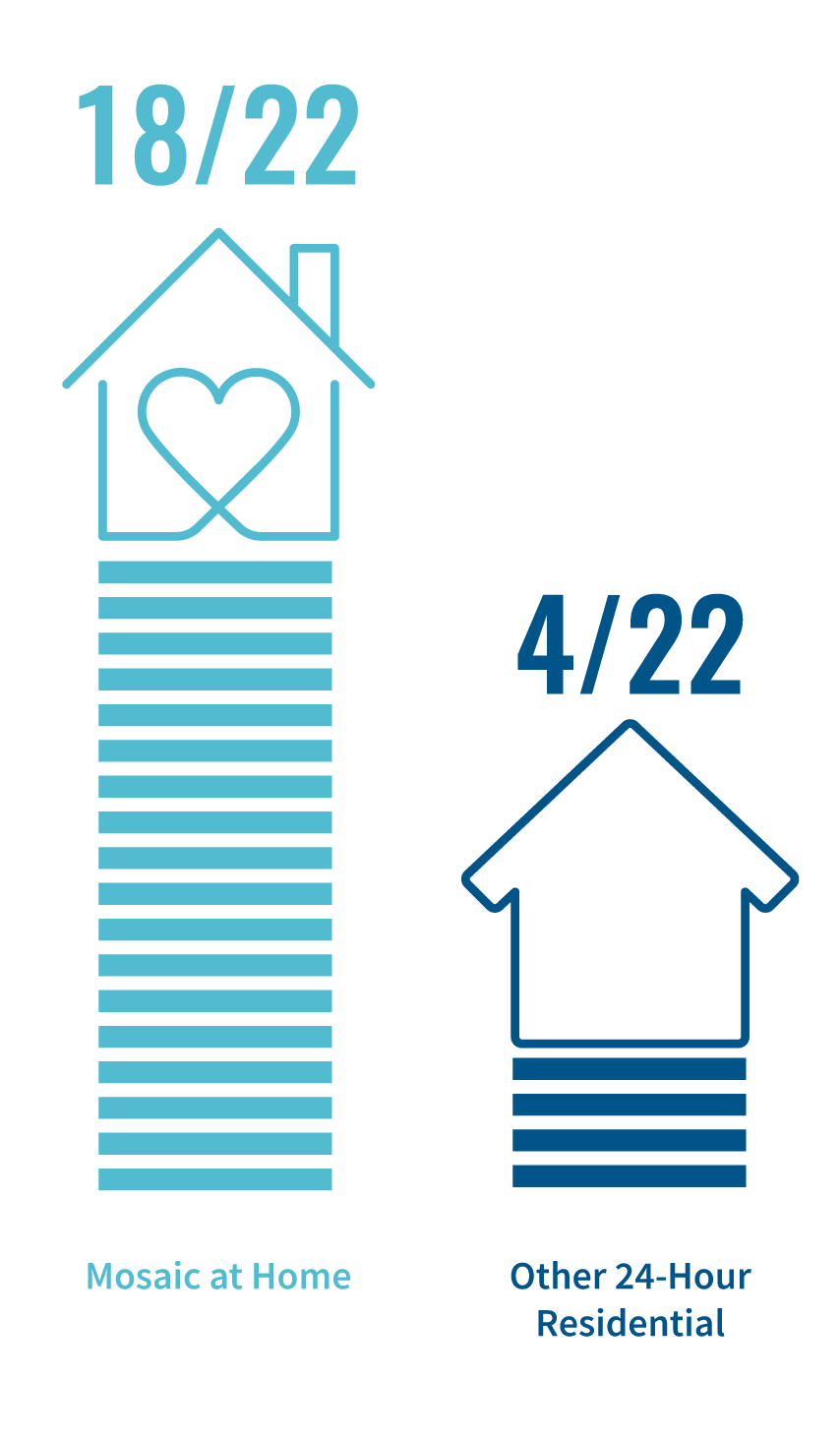
Mosaic at Home POM data compared to other 24/7 residential services
Three Mosaic at Home Personal Outcome Measures that indicated high levels of success are people who are able to:
- Choose where and with whom to live.
- Participate in their communities.
- Experience continuity and security.
While all three of these outcomes contributed to fewer ER visits, “People with IDD who chose where and with whom to live in the community had a 74% decrease in emergency room visits compared to people with IDD who did not choose where and with whom to live.”*
Mosaic President and CEO Linda Timmons sums it up best: “All of those little positive changes in someone’s life are important. They make the difference between thriving and living.”
If you’re interested in Mosaic at Home for someone with IDD, go here on our website.
*Friedman, C. (2021). Choosing Home: The Impact of Choosing Where to Live on People With Intellectual and Developmental Disabilities’ Emergency Department Utilization.
Growth in Kansas
Including my eight-year tenure with Mosaic along with executive directors Leslie Lackamp in Southeast Kansas and Janeth Trevizo in Southwest Kansas, we have a combined 39 years of experience:
Leslie has been with Mosaic for 14 years. Prior to that, she worked with another IDD service provider for 20 years. She is also a board member with the Southeast Kansas Area Agency on Aging (SEKAAA), an advocacy group for seniors. Leslie has a bachelor’s degree in science and is president of the Pittsburg Tri Sigma Area Alumnae Chapter.
Janeth has been with Mosaic for 17 years, serving people we support in a variety of roles—such as a targeted case manager, community relations manager and a quality manager—before becoming executive director. She earned an associate degree in general studies from Seward County Community College in Liberal.
Consider Mosaic As Part of Your Estate Plan
Generosity comes in many forms. We will work with you to find a charitable plan that lets you provide for your family and support Mosaic.
I am grateful for your support and love for Mosaic. You help Mosaic provide essential services and opportunities to empower those we serve.
Thank you for being a valued partner in our Mission.
Sincerely,
Rochelle Cross
State Operations Director

About the Author
Rochelle Cross is the State Operations Director for Kansas and Executive Director of Mosaic in Northeast Kansas and Mosaic in North Central Kansas.
With Mosaic for eight years, Rochelle is certified as a Council on Quality and Leadership (CQL) Personal Outcomes MeasuresⓇ (POMs) interviewer; POMs are considered the intellectual and developmental disabilities service industry’s only valid and reliable tool to measure quality of life. She also holds an associate degree in long-term care administration and a bachelor’s degree in business administration.