


Donor Gifts Change Peoples’ Lives
Mosaic is a whole-person healthcare organization, and generous donors help the people we support lead fuller and more meaningful lives. While there are countless examples to illustrate how that happens, I think you’ll enjoy reading about how donors made a positive difference for three individuals.

Dance lessons bring new sense of self-confidence
For Jeff, attending a series of dance classes (complete with performances!) has not only helped him stay physically active, it’s improved his self-esteem and ability to connect with others.
“I have been blessed to witness the massive growth and change in Jeff since he started dance class almost two years ago,” said Teresa Kwasa, Mosaic Direct Support Supervisor.
Prior to the class, people who know Jeff said he struggled with confidence and social interactions. But that has all changed now.
“Jeff smiles more, interacts more with his peers, and on dance days, he looks forward to going and talks nonstop about how his class went.” Teresa said. “When Jeff comes back to day services after dance, he always likes to gather his friends and supervisor, showing them his new dance moves.”
This is an activity not funded by Medicaid. But it is clearly beneficial to people—helping them have a more enjoyable, meaningful life. I was lucky enough to see the group perform, and the joy they show when performing is absolutely infectious!

Adoabi’s joy was evident on her face when she went shopping to replace the worn and dirty clothing she had worn for years with new items she was able to choose herself.
Resilience shines through when given an opportunity to thrive
Another person we support had long been neglected before she came to Mosaic. Adaobi is 24 and was raised by a single father whose two other children, like her, have autism. As a teen, she moved into a group home (not operated by Mosaic) with almost two dozen other residents, all of whom are autistic.
It is not an exaggeration to say Mosaic rescued her from that group home.
Adaobi had been referred to Mosaic by her state case worker, who said she was not thriving where she was living. When Tori Larson, a Mosaic at Home Supervisor, visited Adaobi to talk about moving to a shared living setting with Mosaic at Home®, she was shocked and saddened by what she saw.
“She was sleeping on a twin-size mattress on the floor,” Tori said. “In a room with bare walls, she had a desk and an old kitchen chair and said she hadn’t had a TV since childhood.” Her mattress was stained so badly, it was thrown out when she moved to Mosaic.
In addition to that, no one had ever taught her basic hygiene, such as how to take a shower and stay clean. She had not received new clothing for years and had been wearing the same clothes since high school. The 15 or so shirts and two pairs of pants she owned had holes and stains.
When we moved her into shared living, she had no funds to buy any of the items she needed. She receives minimal funding, so is only able to save about $6 a month after she pays for her groceries—she buys all of her own food to meet her dietary needs as a Muslim.
Gifts from donors allowed her to purchase a new mattress and frame, wall hangings and curtains for her room, shoes that fit and new clothes. Tori described taking her shopping.
“She was dancing and singing her own song, spelling out e-u-p-h-o-r-i-c,” Tori said. “Unpacking her clothes at home, Adaobi said, ‘It smells so clean!’”
She is now thriving, even going to college.
“This girl is just amazing, she is so resilient,” Tori said. “She’s been forgotten about and neglected by previous agencies, but she still has this desire to get out there and thrive.”
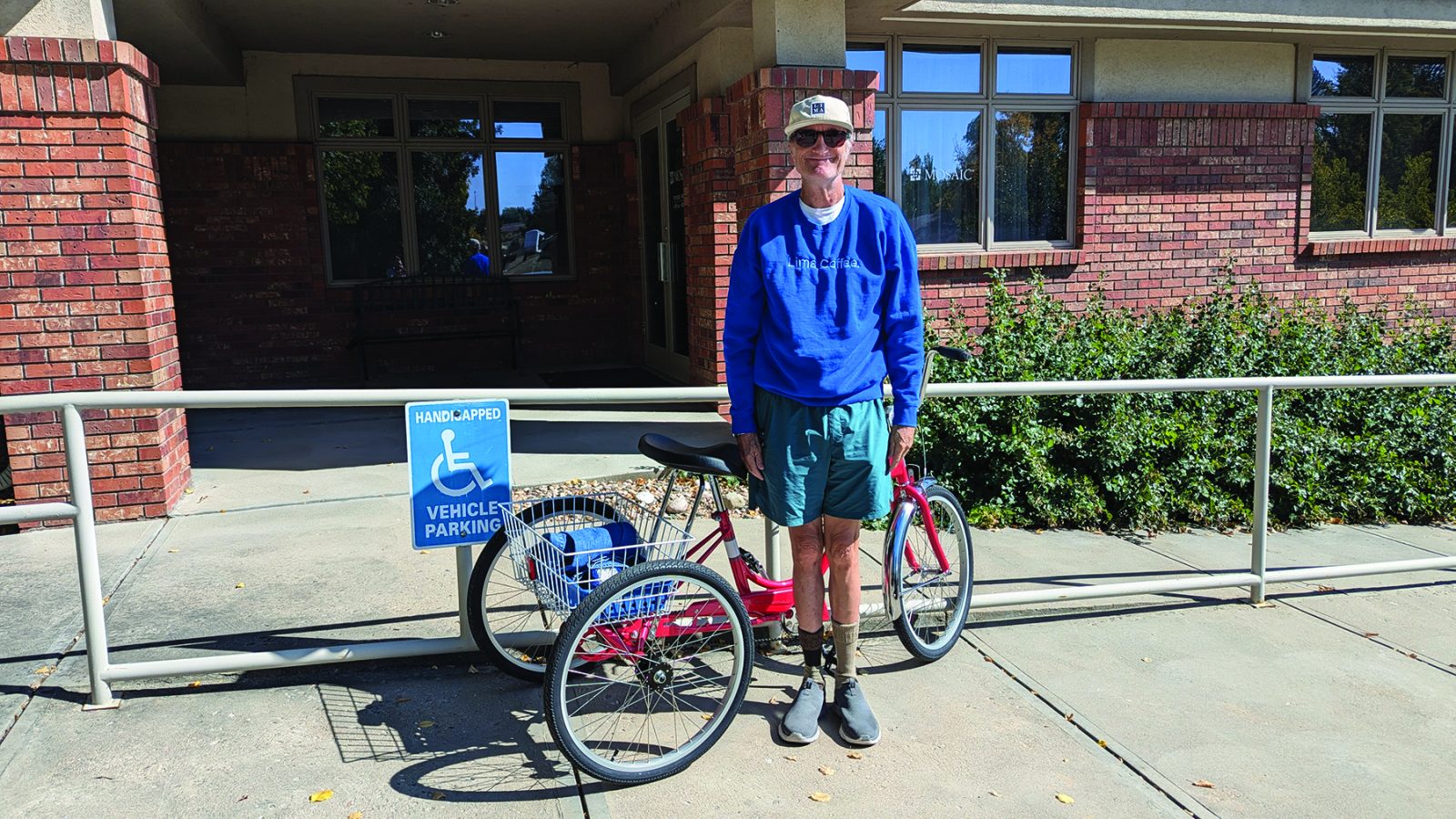
Occasionally Pat stops by the Mosaic office to have coffee and a chat with the local director. He’s also wearing some of the gear his favorite coffee shop gave him, because he’s “the Mayor” there!
Connected to his community once again
For Pat, getting out and about is his lifeline. But his ability to thrive almost came to an abrupt end when his three-wheeled bicycle broke down.
Pat lives independently and receives as-needed support, but his bicycle means freedom, because he can get out in the community to his favorite coffee shops and other places where he is known and welcomed.
“He considers the community his close family friends,” said Desarae Williams, Supervisor for the Independent Living program. “Those interactions he has are the community for him. They are the people he met on his own. He is that guy that sits in the coffee shop and chats with people.”
At his favorite coffee shop, Lima Coffee Roasters, he is so well-known and liked that the owners even offered him a job, which he politely declined since he’s retired. He also has a nickname there–the Mayor of Lima.
“Pat has no relatives who live in the area,” Desarae said. “Having a bike to be able to ride around in the community is a big thing for him. He will ride miles to go where he wants—to watch the community fireworks, to visit the old town area or even go out for dinner.
“When his bike broke, he asked, ‘How am I supposed to get out?’ We gave him rides, but it took away his ability to go when he wants to instead of on someone else’s schedule.”
For people with disabilities, having some control over their life is important. Often in the past, they were told what to do and when to do it. That’s frustrating, as it would be for any of us.
Desarae has known Pat for around 20 years, and worked directly with him for the past seven. She doesn’t remember him without a bicycle. The team knew they needed to act quickly to keep Pat from feeling isolated or growing depressed.
It was about a month before they were able to get the bike purchased. He was excited to see it, Desarae said, with a response something like, “It’s about time, I need my wheels!” Pat rode the bike home from the shop rather than having it delivered.
The mayor is once again able to make his rounds—on his own schedule.
These three stories show that what each person needs to create a full life is unique. They also show the impact of our partners, and I am grateful to all who share in our mission.